Walk into a commercial gym and you will see a hundred machines, each built to look essential. It is easy to assume that getting strong at home means recreating some fraction of that — that you need a leg press, a cable stack, a dozen specialty bars. You do not. The truth is a little deflating and very freeing: almost all of the training that actually builds strength runs through a handful of basic movements, and three well-chosen pieces of equipment cover nearly every one of them.
This is not about suffering through a worse setup to save money. It is about spending money where it counts and ignoring the rest. Let us build the whole thing from the ground up.
Start with the lifts, not the gear
Before you buy anything, get clear on what training actually is. Strip away the marketing and nearly all productive strength work comes down to a short list of patterns: you push something overhead or away from your chest, you pull something toward you, you squat, you hinge at the hips, and you carry or brace loads. Master those patterns under progressively heavier weight and you will build a strong, capable body. Everything else is a variation or an accessory.
That is the lens for every purchase. Do not ask “is this a cool piece of equipment?” Ask “how many of those core patterns does it let me load heavy and progress over time?” Judge gear by that one question and the right shopping list almost writes itself.
Piece one: a barbell and plates (plus a way to rack it)
If you buy nothing else, buy a barbell and plates. Nothing matches a loaded bar for building strength, because nothing else lets you add weight in small, endless increments across the squat, press, row, and deadlift at once. A good barbell will outlast your car. Plates are plates — iron is iron, and you do not need anything fancy to start.
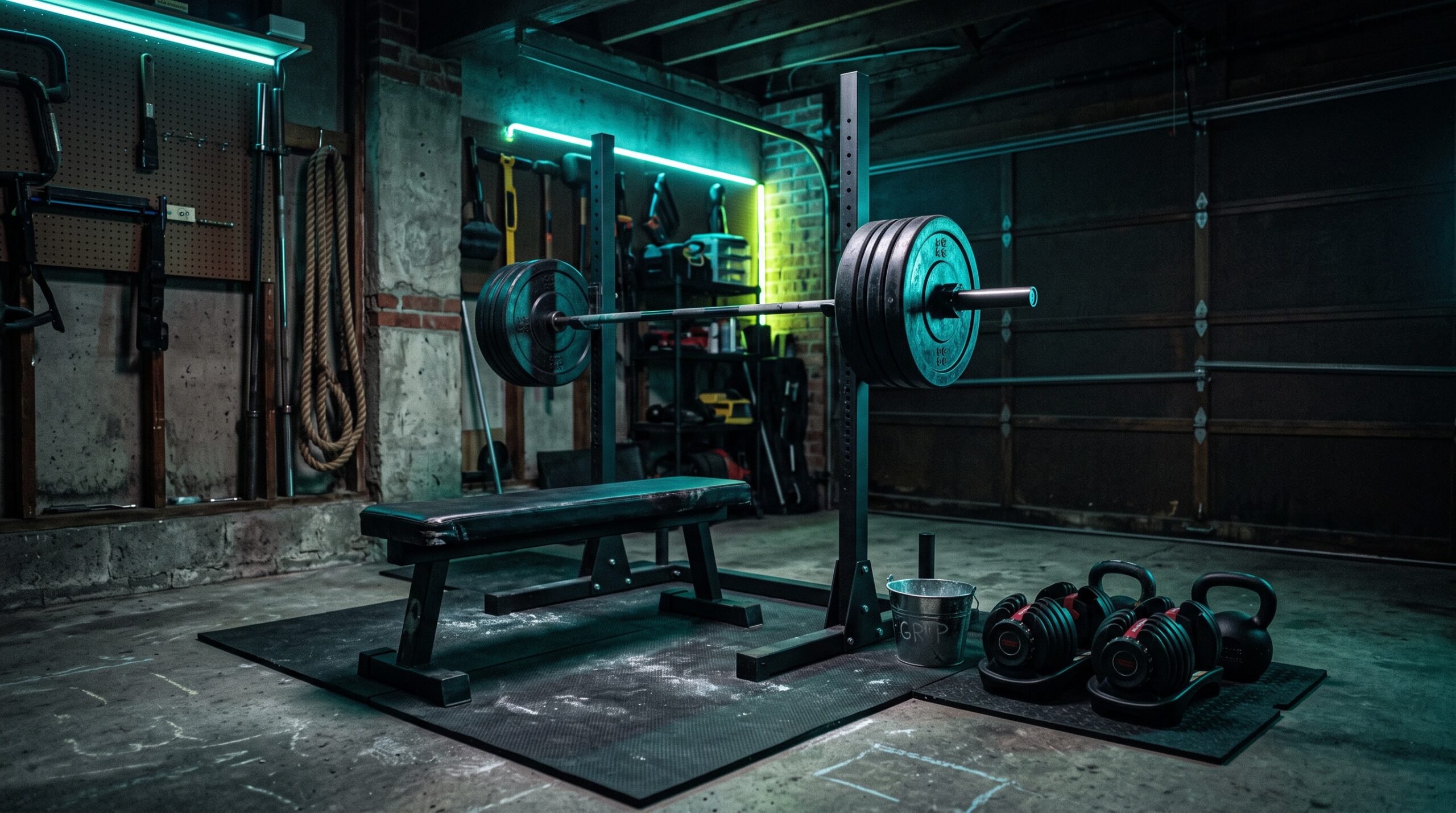
The catch is the squat and the press: you need a way to get the bar onto your back and overhead safely without a spotter. That means a rack. Here is where budget decisions get real. A full power rack with safety bars is the gold standard and worth it if you have the space and money — it lets you bail out of a failed squat or bench without a partner, which matters a lot when you train alone. But a pair of sturdy squat stands costs a fraction as much, takes far less room, and covers most of what a beginner needs. Start with what fits your space and wallet; you can always upgrade later. The bar and plates are the investment that never becomes obsolete.
One caveat worth saying out loud: training heavy at home with no spotter raises the stakes. Learn the movements properly, use safety bars or stands you can dump the weight onto, and do not chase one-rep maxes alone in a garage to prove a point.

Piece two: an adjustable bench
A bench is the quiet multiplier. On its own it does little, but it unlocks a huge amount. Flat, it gives you the bench press — the most direct barbell builder for your chest, shoulders, and triceps. Set to an incline, it opens up incline presses and a whole catalog of dumbbell work: seated presses, supported rows, chest-supported variations that take your lower back out of the equation.
Get an adjustable one if you can swing it — the flat-to-incline range roughly doubles what you can train. A flat-only bench is cheaper and still genuinely useful if money is tight, so do not let the perfect block the good. But of everything on this list, the bench is the piece most people underrate and then wish they had bought sturdier. Buy one that does not wobble under a heavy press.
Piece three: adjustable dumbbells
The barbell is a blunt instrument, and that is a compliment — it is unmatched for heavy, bilateral lifts. But it leaves gaps. Single-arm work, lunges, curls, lateral raises, and all the one-side-at-a-time movements that fix imbalances and round out a physique live in the world of dumbbells. A single pair of unilateral, single-arm and single-leg training tools covers more variety than any other purchase you can make.
The smart buy here is a set of adjustable dumbbells — the dial or pin-selector kind that collapse a whole rack of fixed dumbbells into one pair. They cost more upfront than a single fixed pair, but they replace fifteen pairs and the floor space those would eat. For a home gym where room is usually the real constraint, that trade is almost always worth it.

What to skip (at least for now)
Here is where you save the real money: by not buying the things that feel essential and are not. Skip the machines — leg press, cable stacks, pec decks. They are expensive, bulky, and every one of them duplicates a job your barbell and dumbbells already do. Skip the specialty bars and the endless small gadgets until you have trained long enough to know you actually have a gap. And ignore the impulse to buy a mountain of plates on day one; buy enough to challenge you now and add more as you get strong, because progress takes months, not a single shopping trip.
The one genuinely cheap add-on worth grabbing early is a pull-up bar — a doorway model costs almost nothing and covers the one major pulling pattern a basic barbell setup can leave thin. A rubber mat to protect your floor and your plates is the other small, sensible buy. Beyond that, resist. Constraint is a feature here. A simple setup you actually use beats an elaborate one that becomes a clothes rack — and if you are the type who jumps between programs instead of progressing on one, a minimal gym quietly forces you to stop collecting and start lifting.

Build it in order
If you cannot buy everything at once, buy in this order: barbell and plates with a rack or stands first, then a bench, then adjustable dumbbells, with a doorway pull-up bar slotted in whenever. Each stage is a complete, trainable gym on its own — you can build real strength with nothing but a loaded bar and a rack while you save for the rest. That is the whole point of choosing based on movement patterns instead of machines: every piece earns its place by unlocking real work, so there is never a stage where your gym does not do the job.
A strong body is not bought, it is built — slowly, under a bar, on days you did not feel like it. The gear just has to get out of the way and let you load the lifts that matter. Three pieces do that. Spend your money there, skip the shiny distractions, and put the energy you would have wasted shopping into showing up and adding weight. That is the part no amount of equipment can do for you.