Here is the frustrating truth: you can train with perfect form, chase every rep, and still watch the scale and the mirror refuse to budge. You did not out-train your genetics. You out-trained your fork. Muscle is built from protein, and if you do not give your body enough of it, the hard work you put in under the bar has nothing to build with. The good news is that the protein question is far simpler than the supplement industry wants you to believe. You do not need eight small meals or a shake every ninety minutes. You need a daily number, a handful of solid sources, and the consistency to hit it. Let us nail down exactly how much protein you need to build muscle – and how to actually eat it.

Why Protein Is the One Macro You Cannot Fake
Every time you train hard, you create tiny amounts of damage in your muscle fibers. That is the point. Your body responds by repairing those fibers and building them back slightly bigger and stronger – a process called muscle protein synthesis. The raw material for that repair is the amino acids in the protein you eat. No protein, no bricks. It does not matter how good the blueprint is if the truck never shows up with the materials.
This is why protein is the macro you cannot fudge. You can build muscle on higher carbs or lower carbs, more fat or less. But protein is non-negotiable, because it is literally what your muscle is made of. Training is the signal that says “build.” Protein is what you build with. That signal, by the way, only counts if you are actually giving your muscles a reason to grow – which comes down to steadily doing more over time, the principle we broke down in progressive overload. Get both right and you are unstoppable. Get either wrong and you spin your wheels.
The Number: How Much You Actually Need
Here is the target the research keeps landing on for people who lift: roughly 0.7 to 1 gram of protein per pound of bodyweight per day. In metric, that is about 1.6 to 2.2 grams per kilogram. For most lifters, the sweet spot sits right around 0.8 to 1 gram per pound.
Run the math on yourself. If you weigh 180 pounds, you are aiming for roughly 145 to 180 grams of protein a day. Weigh 150? Target about 120 to 150 grams. That is your whole plan in one line. You do not need to go higher – stuffing in 300 grams does not build muscle faster, it just fills you up and crowds out other food. And you do not want to go much lower, because that is exactly where progress quietly stalls.
One tweak worth knowing: if you are carrying significant extra body fat, base the number on your target or lean bodyweight rather than your total scale weight, so you are not chasing an unnecessarily huge figure. And if you are dieting to lose fat while keeping muscle, push toward the higher end – protein is even more protective when calories are low.

Timing Matters Less Than You Think
For years the gym world was terrified of the “anabolic window” – the idea that if you did not slam a shake within thirty minutes of your last set, your gains would evaporate. It is a myth. Research on nutrient timing shows the window is much wider and more forgiving than the supplement labels suggested; your body is still primed to use protein for many hours after you train.
What actually helps is distribution. Instead of eating almost nothing all day and then a giant steak at night, spread your protein across three or four meals of roughly 30 to 50 grams each. Each of those meals gives muscle protein synthesis a fresh nudge, and each one supplies a solid dose of leucine, the amino acid that flips the “build” switch. So aim for a protein source at every meal rather than obsessing over a stopwatch after training. Steady beats frantic.
The Best Protein Sources (No Powder Required)
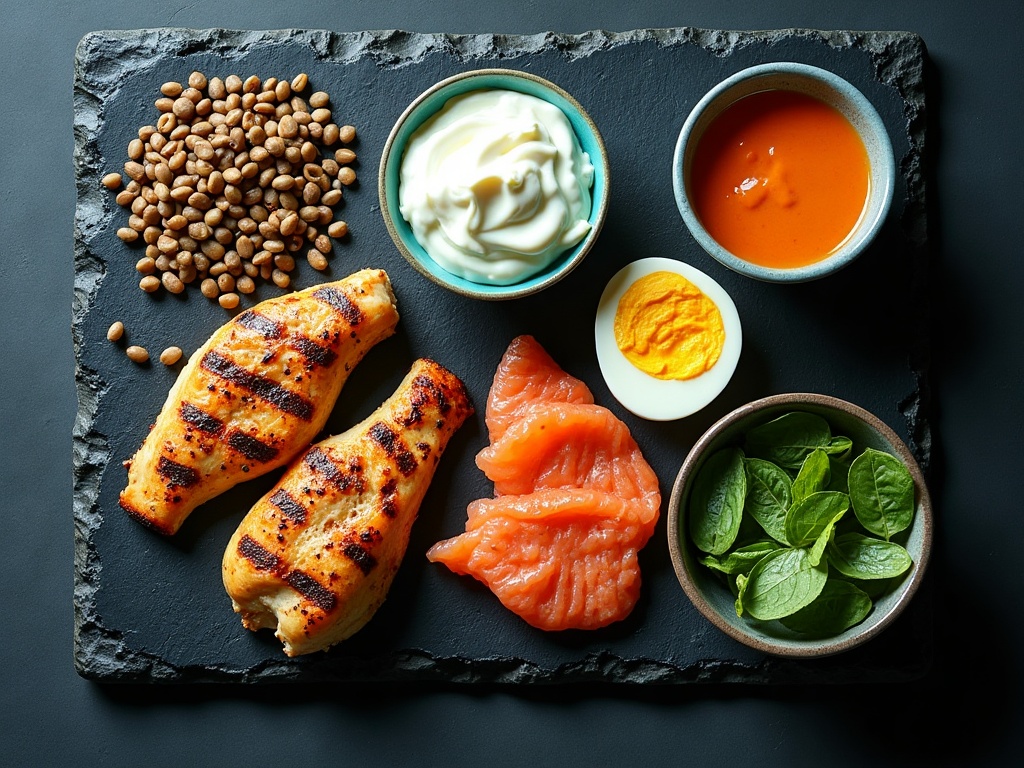
You can hit your entire number with regular food. Powder is a convenience, not a requirement. Lean toward complete proteins – ones that carry the full set of amino acids your muscles need:
Chicken and turkey breast, lean beef, pork, and fish like salmon and tuna are the heavy hitters. Eggs and dairy – Greek yogurt, cottage cheese, milk – are cheap, easy, and protein-dense. If you eat mostly plants, lean on lentils, beans, tofu, tempeh, edamame, and seitan, and simply eat a bit more total since plant sources are often a touch less concentrated. Whey or a plant protein powder earns its place for one reason: it makes hitting a big number easy on busy days. A scoop is 25 grams in ten seconds, no cooking required.
How to Actually Hit Your Number
Knowing the target is easy. Hitting it every single day is where people fall apart. A few moves make it almost automatic:
Anchor every meal around a protein first, then build carbs and veggies around it – not the other way round. Front-load some of it early; a high-protein breakfast means you are not staring down a 100-gram deficit at 8 p.m. Keep lazy options on hand for the days life gets in the way: a tub of Greek yogurt, a couple of hard-boiled eggs, a can of tuna, a shaker of powder. And for a week or two, actually track it. Most people wildly overestimate how much protein they eat, and a few days of honest logging is a rude but useful wake-up call. Consistency here is the same muscle you train everywhere else – it is the same reason a small, repeatable dose you actually stick to beats a perfect plan you abandon by Wednesday.
Protein Is Only One Leg of the Stool
Do not let the protein focus fool you into thinking it works alone. Muscle is built at the intersection of three things: a training stimulus hard enough to demand growth, enough protein to supply the repair, and enough recovery for the rebuild to happen. Skip any one and the other two cannot save you. That third leg is the one lifters neglect most – the actual rebuilding happens while you rest, especially while you sleep. You can eat a perfect 180 grams and train like a savage, but on four hours of sleep your body simply will not put it all to work.
So think of it as a stool with three legs. Protein is the leg most people cut short because it is the most invisible – no one sees your macros the way they see your workout. But it is the difference between training that adds up and training that just makes you tired.

Eat to Build, Not Just to Train
You do not need to be perfect. You need to be consistent. Pick your number – somewhere around 0.8 to 1 gram per pound of bodyweight – spread it across your meals, lean on whole foods with a shake to fill the gaps, and hold that line most days of the week. Do that alongside smart, progressive training and real recovery, and the muscle you have been chasing finally has everything it needs to show up.

The bar builds the demand. Your kitchen supplies the answer. Log your lifts, hit your protein, and let the two do their quiet work. Now go eat like you actually train – and track it, so the only guesswork left is how much weight to add next week.
Sources & further reading: