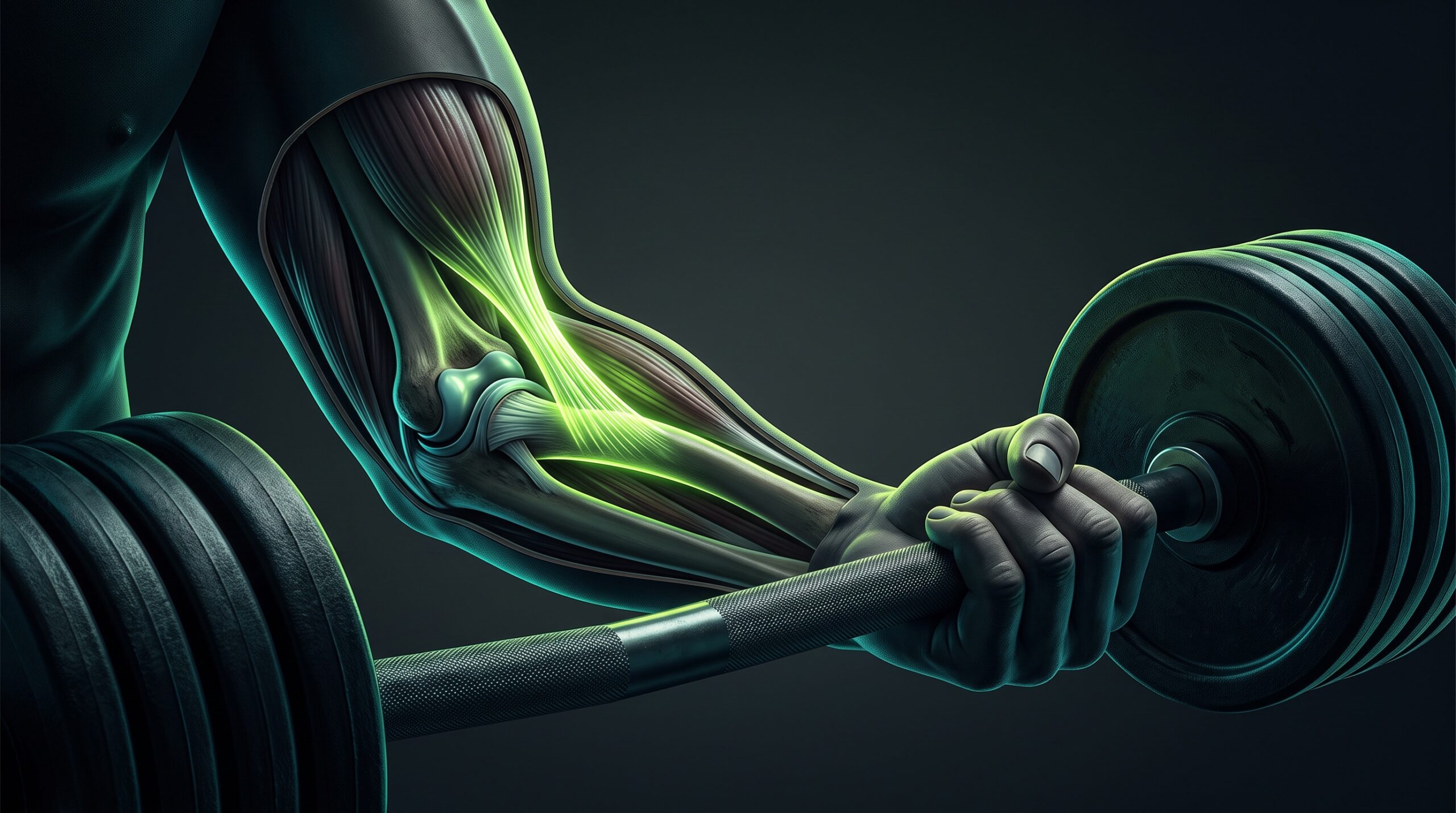
You add weight to the bar, your muscles answer, and for a few months everything feels unstoppable. Then one day your elbow starts barking on every curl, or your knee aches going down stairs, or the front of your shoulder lights up on the bench. Nothing tore. You didn’t do anything stupid. Your muscles simply got strong faster than the cables holding them to your bones could keep up – and now those cables are complaining.
Those cables are your tendons, and they are the most ignored tissue in the gym. Lifters obsess over muscle and barely think about the connective tissue doing the actual job of transmitting force. That’s a mistake, because a tendon that can’t handle what your muscle can produce is exactly where a strong, consistent training career quietly goes to die.
Why muscle races ahead and tendons lag behind
Muscle is a busy, blood-rich tissue. It adapts fast – you can measurably strengthen it in weeks, which is why newcomers feel like they’re flying early on. Tendons are the opposite. They’re dense, fibrous, and poorly supplied with blood, so they turn over their collagen and remodel themselves on a timeline measured in months, not weeks.
That difference is the whole problem. Run a program hard for a couple of months and your muscles may be pulling with far more force than your tendons have adapted to carry. The tissue gets irritated, micro-damage outpaces repair, and you end up with the dull, persistent ache of a tendinopathy – the catch-all name for an unhappy, overloaded tendon. It rarely announces itself with a dramatic pop. It creeps in, and by the time you notice, you’ve been outrunning your connective tissue for a while. It’s the same principle behind why smart strength work keeps runners healthy: tissue that’s gradually prepared for load holds up, and tissue that’s surprised by it breaks down.
What actually makes a tendon stronger
Here’s the encouraging part: tendons respond to training. They get thicker, stiffer, and better at storing and returning energy – they just need the right signal, and the right signal is heavy, slow, and sustained.
Tendons care about two things above all: the size of the load and how long that load is applied. Light, fast, bouncy reps barely register with them even when they leave your muscles burning. What a tendon wants is meaningful weight held under tension for several seconds at a time, repeated patiently over weeks. Think grinding, deliberate reps rather than explosive ones. This is why heavy, controlled training – the kind where you own every inch of the movement – does so much more for your joints than frantic, momentum-driven sets.

It’s also why a proper warm-up ramp protects your joints rather than wasting time: easing the tissue up to a heavy load with progressively heavier sets primes the tendon before you ask it for everything. You’re not just greasing the muscle – you’re giving the connective tissue a few gentle rehearsals before the real demand arrives.
Isometrics: the first tool for an angry tendon
When a tendon is already sore, the instinct is to rest it completely. That usually backfires – a detrained tendon gets weaker and comes back even less tolerant of load. The better move is to load it in a way that doesn’t aggravate it, and the gentlest way to do that is an isometric: pushing or holding against a fixed resistance with no movement at all.
A long, hard isometric hold – say, pressing into an immovable bar or holding a heavy position for twenty to forty seconds – puts real, sustained tension through the tendon while sparing it the irritating stretch-and-rebound of full reps. Physios reach for these first in tendon rehab for exactly that reason, and they often take the edge off the pain in the moment too. If you want the full how-to on loading a joint without moving it, it’s worth getting deliberate about using isometrics as a lifter, because they’re as useful for building resilient tendons as they are for busting through sticking points.
Eccentrics and tempo: the classic rebuild
Once a tendon tolerates isometric load, the next step is slow, controlled movement – and the lowering phase matters most. Decades of rehab research point to slow eccentrics, where you take three to five seconds to lower the weight under full control, as one of the most reliable ways to remodel a cranky tendon and build a robust one from the start.

You don’t need a special program to use this. Just slow down. Take a controlled count to lower the bar on every working rep instead of letting gravity do it for you. That single change loads the tendon longer and more completely through the range, and it’s the same discipline behind controlled, high-quality reps in general. A heavy set done with a deliberate three-second lowering phase does far more for your connective tissue than the same weight dropped and bounced.
How to build tendon work into a normal program
You don’t need a separate tendon day. You need a few habits layered onto what you already lift:
Slow your eccentrics on your main lifts – a controlled three-count on the way down, every working set. Add one isometric hold for any joint that tends to nag, two or three long holds at the end of a session. Progress load gradually and resist the urge to jump weight every week just because your muscles could handle it; the tendon is the slower partner, so let it set the pace. And respect warning aches – a tendon that’s grumbling wants managed load, not either total rest or a new personal best.
Nutrition plays a supporting role too. The building blocks of tendon – collagen and its raw materials – get more useful when you’re actually loading the tissue, which is why timing some protein or collagen around your training is worth a look, even if it’s a minor lever next to the loading itself. And none of this gets less important with age – if anything, connective tissue stiffens over time, which is part of why lifting matters more after 40, not less.
The patience a tendon demands

Here’s the hard truth about tendons: they heal and adapt on their own clock, and that clock does not care about your training ego. You can’t rush a tendon the way you can bully a muscle into one more rep. Pushing harder when a tendon is telling you to back off is how a two-week annoyance becomes a six-month problem.
That makes tendon work a test of the one quality the gym constantly tries to erode: patience. The slow reps, the gradual load increases, the willingness to hold back a little today so you can train hard for years – none of it photographs well, and none of it gives you the instant hit of a big lift. It’s the quiet, unglamorous work that keeps you in the game, and it’s a lot easier to stay patient and present for it when your attention is on the tension in the tissue instead of split between your set and a phone lighting up on the bench beside you.
Pick the joint that nags you most, slow your reps down this week, add a couple of long holds, and ease the load up a little slower than you think you need to. Your muscles will barely notice. The cables holding them together will thank you for years.