Picture a lifter in a power rack, hands on a barbell set on the pins, pushing up with everything they’ve got. The bar doesn’t budge. No rep gets counted. To a bystander, nothing is happening. But under the skin, that lifter is firing more muscle fibers than they would on most of their working sets – and getting stronger for it. That’s an isometric, and it’s one of the most underused tools in the gym.
An isometric contraction is simple to define: your muscle generates force, but the joint angle doesn’t change. You push or hold, and nothing moves. No lowering phase, no lifting phase – just tension. It sounds almost too basic to matter, but the training effect is real, specific, and genuinely useful whether you’re chasing a bigger bench or working back from a cranky joint.

Two kinds of isometric, and why the difference matters
There are two flavors, and lifters use them for different jobs.
An overcoming isometric is when you push against something that cannot move – a loaded bar pinned in a rack, a bar pressed into safety stops, a strap bolted to the floor. You’re trying to move an immovable object, so you can throw maximum intent into it with zero risk of the weight crashing down on you. These are your strength and sticking-point tools.
A yielding isometric is when you hold a loaded position and resist being moved – pausing at the bottom of a squat, hanging at the midpoint of a chin-up, or holding a dumbbell at a dead stop halfway through a curl. Here gravity is winning the moment you let the position collapse, so your job is to hold the line. These build control, stability, and brutal time-under-tension.

Both are isometric because the joint angle stays fixed. The practical difference is intent: in an overcoming hold you’re trying to produce as much force as possible against a dead stop, while in a yielding hold you’re trying to not lose a position you’re already in.
Why a motionless push makes you stronger
The catch with isometrics – and it’s a feature, not a bug – is that they build strength most powerfully at the exact joint angle you train, give or take about fifteen degrees in either direction. Train a hard push with your elbows bent at ninety degrees and that’s where you’ll see the biggest carryover. This is called angle specificity, and it’s the whole reason isometrics are so good at fixing a stubborn weak point.
They also let you generate enormous force safely. Because nothing is moving and nothing can fall, you can recruit your highest-threshold muscle fibers without worrying about failing a rep or losing control of the bar. A maximal six-second push into the pins teaches your nervous system to fire hard – and that’s a skill that follows you back to your regular lifts. Add the fact that you need almost no fancy equipment, and the appeal becomes obvious: a rack, a wall, a sturdy strap, and your own effort.
Using isometrics to kill a sticking point
Every lifter has one – the spot in a lift where the bar slows to a crawl and stalls. A few inches off the chest on the bench. Just out of the hole on a squat. Shin height on a deadlift. That sticking point is where you’re weakest through the range, and it’s exactly where an overcoming isometric shines.
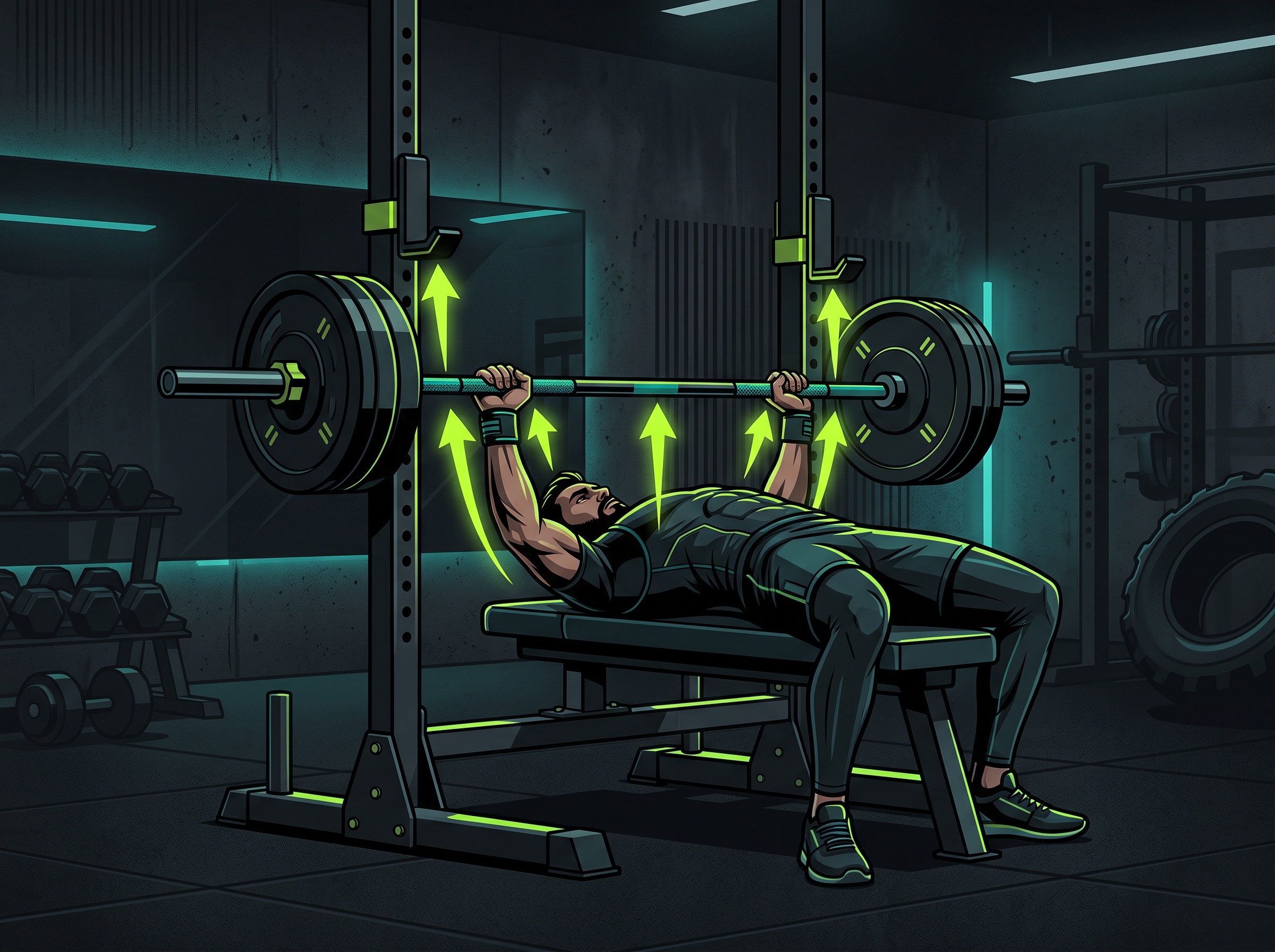
The setup is straightforward. Put the bar on pins (or in a rack) at your sticking-point height, load it, and push into it as hard as you can for around three to six seconds, then relax and reset. Treat it like a max-effort set: full intent, braced hard, a handful of all-out pushes rather than a long easy hold. Because you’re training strength right at the angle you tend to fail, the carryover to the actual lift can be fast. It pairs naturally with the kind of controlled, position-aware work you already do with pause reps and tempo training – all three attack the parts of a lift that a normal touch-and-go set lets you rush through.
When you can’t lift heavy – but still want to train
Isometrics earn their keep on the days a normal program can’t. Tweaked a joint and can’t tolerate a full range of motion? A pain-free isometric hold often lets you keep loading the muscle without aggravating the sore spot – which is why physios lean on them so heavily in early rehab. Traveling with nothing but a hotel room and a towel? You can push a hand against a wall, press into a doorframe, or hold a wall-sit and still give the muscle a real reason to adapt.
They’re also the cleanest way to train when you simply can’t make noise or need almost no gear – no clanging plates, no setup, just you producing force. It’s the same spirit as the overlooked movements that build real-world strength: unglamorous, effective, and available anywhere.
How to program them without overthinking it
You don’t need a separate isometric phase to benefit. Bolt them onto what you already do. For strength and sticking points, add two to four maximal overcoming pushes of three to six seconds at the end of your main lift, resting fully between each the way you would for any heavy single. For stability and muscle-building, add a yielding hold – thirty seconds in a loaded position, or a long pause at the hardest part of a movement – after your regular sets.
Bracing matters as much here as under a moving bar. Set your feet, fill your belly with air, lock your ribs down, and only then push – the same full-body tension you’d use for a heavy single. If that cue feels vague, it’s worth getting deliberate about how you brace your core under load, because an isometric is pure bracing with nothing to distract from a sloppy setup.
One honest limitation: because the strength gain is angle-specific, a single hold won’t make you stronger through a whole range of motion. If you want to cover the full lift, train isometrics at two or three positions – bottom, middle, and near lockout – rather than just one.
The quiet discipline isometrics demand
Here’s the part nobody mentions: isometrics are boring to watch and impossible to fake. There’s no bar flying up to make you feel heroic, no rep count ticking over. It’s just you, a fixed point, and six seconds of deciding to push with genuine maximum effort. Phone it in and you get nothing; commit fully and you get everything.
That makes them a perfect gut-check for your focus. You can’t scroll through a maximal isometric – the second your attention drifts, your force output falls off a cliff and the set is wasted. So treat the hold as what it is: a few seconds that demand all of you. Set up, brace, push like you mean it, and give each rep the kind of full attention that’s a lot easier to find when your phone is zipped in your bag instead of lighting up on the bench beside you.
Add a few focused isometric pushes to your next session at whatever point in a lift gives you the most trouble. No movement, no spectacle – just the quiet, specific work of getting strong exactly where you need it.