The barbell is the best friend you have in the gym, and also a little bit of a liar. Load up a squat or a bench press and both sides work together – which sounds great until you realize what “together” really means. Your stronger side quietly picks up the slack for your weaker one. The bar still goes up. Your imbalance never shows its face. And it slowly gets worse under a pile of plates you’re proud of.
Unilateral training – working one leg or one arm at a time – is how you call that bluff. It’s not a fancy add-on for advanced lifters. It’s one of the most honest, high-return tools you can put in a program, and most people skip it.
What “unilateral” actually means
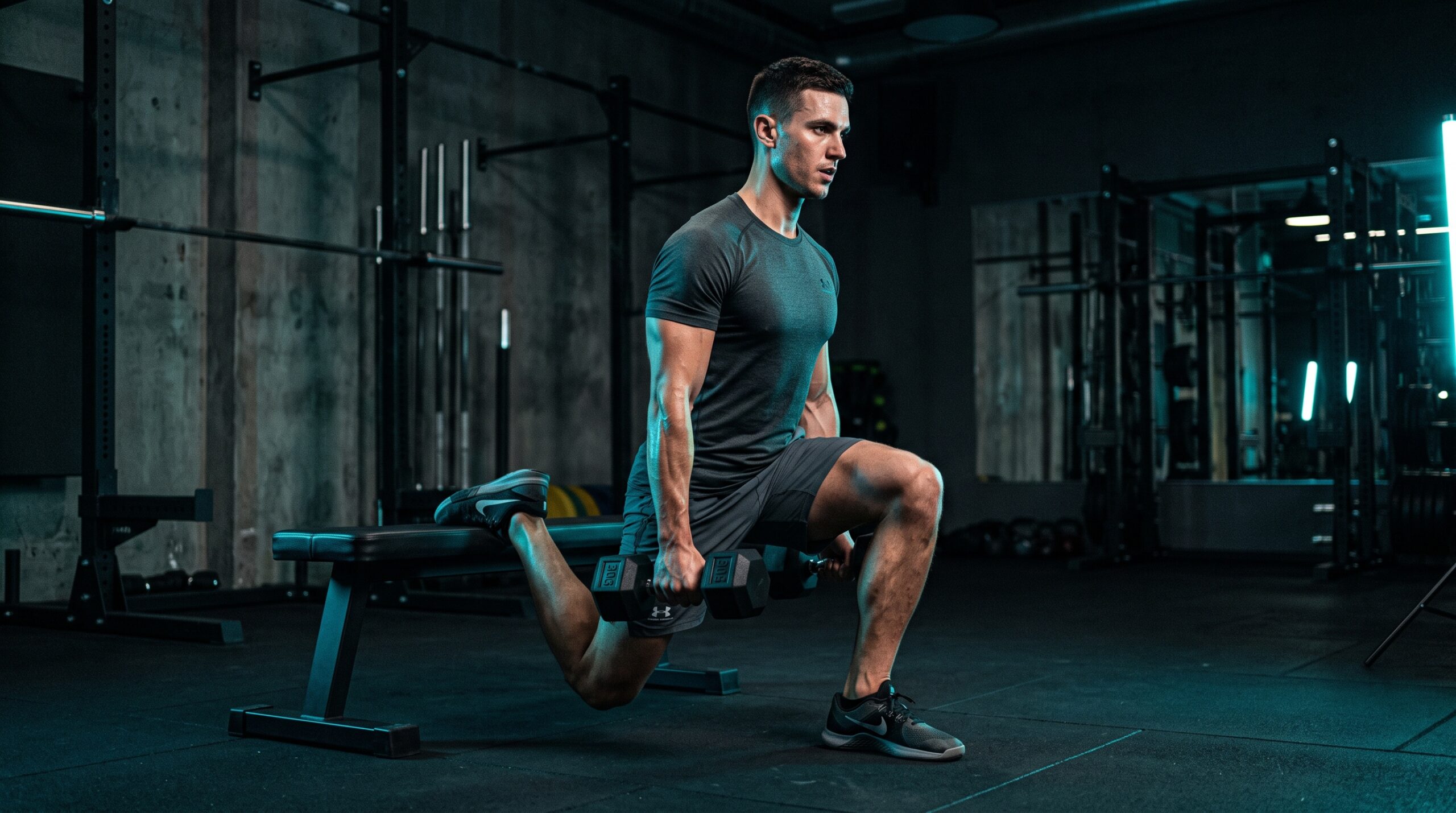
Bilateral means both limbs at once: back squat, barbell bench, deadlift, overhead press. Unilateral means one at a time: Bulgarian split squats, walking lunges, single-leg RDLs, single-arm dumbbell rows and presses. That’s the whole vocabulary. The difference sounds small. What it exposes is not.
The hidden problem: your strong side is a cheater
Everybody has a stronger side – usually the dominant one. On a barbell, that side can take a little more of the load, shift your hips a few millimeters, press a touch harder, and you’ll never feel it. The weight is shared, so the gap stays invisible. Over months and years, the strong side keeps getting the better workout and the gap widens.
Put a single dumbbell in one hand or all your weight on one leg, and that game is over. There’s no other side to lean on. Each limb has to do its own full job, which means your weaker side finally gets trained as hard as your stronger one instead of coasting. That alone is worth the price of admission.
You get core and stability work for free
Here’s the part people underrate. When you load one side of your body, you create an off-balance force trying to twist and tip you. Your core, hips, and all the little stabilizers have to fire hard to keep you square and upright. You’re not just training the working arm or leg – you’re training everything that stops you from folding sideways.
That’s real, usable stability, the kind that transfers to sport, to carrying a kid on one hip, to catching yourself when you stumble. A barbell on your back doesn’t ask for it in the same way. This is the same reason big lifts and single-side lifts do different jobs, which is worth understanding alongside how compound and isolation exercises each earn their place in a smart workout.
It’s easier on you than you’d think
Unilateral work usually means dumbbells, and dumbbells are gentle on your joints in a way a fixed barbell path sometimes isn’t. Your hand and shoulder can find the position that feels right instead of being locked to a bar. You can train hard with less total load on your spine, because a pair of moderate dumbbells in a split squat challenges the working leg plenty without a heavy bar crushing down on you.
That’s a big deal on days your lower back is cranky, and it’s part of why dumbbells hold their own for building muscle – something we dug into in the free weights versus machines breakdown. Less spinal load, same hard effort where it counts.
The moves worth knowing
You don’t need a dozen exercises. A few cover it:
- Bulgarian split squat – rear foot on a bench, all the work on the front leg. Brutal, humbling, and one of the best single-leg builders there is.
- Walking or reverse lunges – simple, scalable, and great for balance and quad-glute strength.
- Single-leg Romanian deadlift – hammers the hamstrings and glutes while your ankle and hip learn to stabilize.
- Single-arm dumbbell row – full range for the back, and your core fights the rotation the whole time.
- Single-arm dumbbell or landmine press – exposes a weak shoulder and forces your torso to resist the twist.
How to fit it in
You don’t have to overhaul anything. Add one or two unilateral moves as accessory work after your main barbell lift. Squat day? Follow it with split squats. Pull day? Add single-arm rows. Two to three sets of 8-12 reps per side is a solid starting point.
One rule that pays off: start with your weaker side, and let it set the numbers. Whatever reps your weak side can do with good form, match on the strong side and stop there – don’t grind out extra reps just because you can. That’s how the gap actually closes instead of quietly growing. Unilateral work slots cleanly into most programs, whether you run full-body days or a split – see how the common training splits are built if you’re still deciding on your structure.

The takeaway
The barbell builds strength, but it also lets your body cheat in ways you can’t feel. Single-leg and single-arm work takes that option away: each side does its own job, your core earns its keep, and the imbalance you didn’t know you had gets fixed before it turns into a tweak or a plateau. Add a couple of unilateral moves a week, lead with your weak side, and lift like both halves of you are actually pulling their weight.
The catch with single-side work is that it’s easy to lose count and lose the plot when you’re balancing on one leg and half-watching your phone. Keep your head in the set, log your reps per side honestly, and let a quiet timer run the rest – that’s the kind of focus, minus the scroll, that Kalaku is built to protect. Train one side at a time, and stop hiding from your weak side.